

Guangermei Precision Components | AI Digital Asset Website Case for Industrial Workstation Equipment (Chinese)
Developing an AI digital asset website for manufacturers of workbenches, tool cabinets, and industrial workstation equipment. Leveraging 394+ product materials, an AI knowledge base, AI Worker automated operations, and internal link matching to continuously accumulate product and industry content.
Specifications
- Industry
- Industrial Manufacturing / Workstation Equipment / Storage Equipment
- Enterprise
- Huizhou Guangermei Precision Components Co., Ltd.
- Site Language
- Simplified Chinese
- Project Type
- AI Digital Asset Website
- Core Capabilities
- AI Enterprise Knowledge Base / AI Worker / Automated Inspection / Content Scoring / Automated Publishing / Automated Internal Link Matching
- Product Scale
- 394+ Product Materials
- Operational Status
- Continuously Operating
Project Background
Huizhou Guangermei Precision Components Co., Ltd. is a manufacturing enterprise focusing on the design, production, and sales of workshop workstation equipment, storage equipment, and industrial supporting equipment.
The enterprise's products are widely used in scenarios such as manufacturing, electronics, electrical appliances, auto parts, hardware molds, maintenance and testing, warehousing and logistics, and school practical training.
As the number and categories of products continue to increase, a problem easily arises in traditional enterprise websites:
There are many products, but very little content that can continuously explain the products, application scenarios, and customer issues.
Therefore, this project did not stop at the goal of "building an industrial manufacturing enterprise website," but further established an AI enterprise knowledge base and an automated content operations system, enabling a large amount of product data to be continuously converted into long-term digital assets.
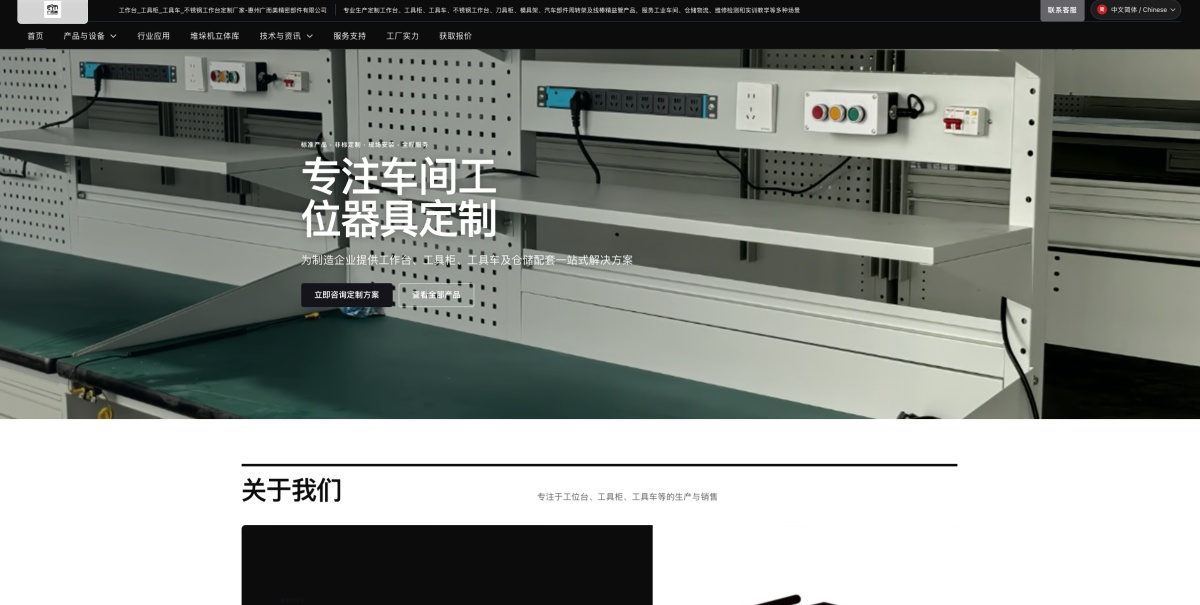
Building the Enterprise Knowledge Base from Massive Product Data
Guangermei has a relatively rich product system.
Currently, the enterprise product database has organized 394 products and split them into 16 categorized knowledge documents.
These include:
- Composite Workbenches
- Stainless Steel Workbenches
- Beech Wood Workbenches
- Iron Plate Workbenches
- Anti-static Workbenches
- Aluminum Profile Workbenches
- Fitter Maintenance Workbenches
- Tool Cabinets
- Tool Carts
- Cutting Tool Cabinets and Cutting Tool Carts
- Storage Racks
- Automated Storage and Retrieval Systems
- Push Carts and Transfer Carts
- Cast Iron Mold Repair Platforms
And other industrial supporting products.
Through this classification method, the originally massive and scattered product data is gradually organized into an enterprise knowledge structure that AI can understand and call upon.
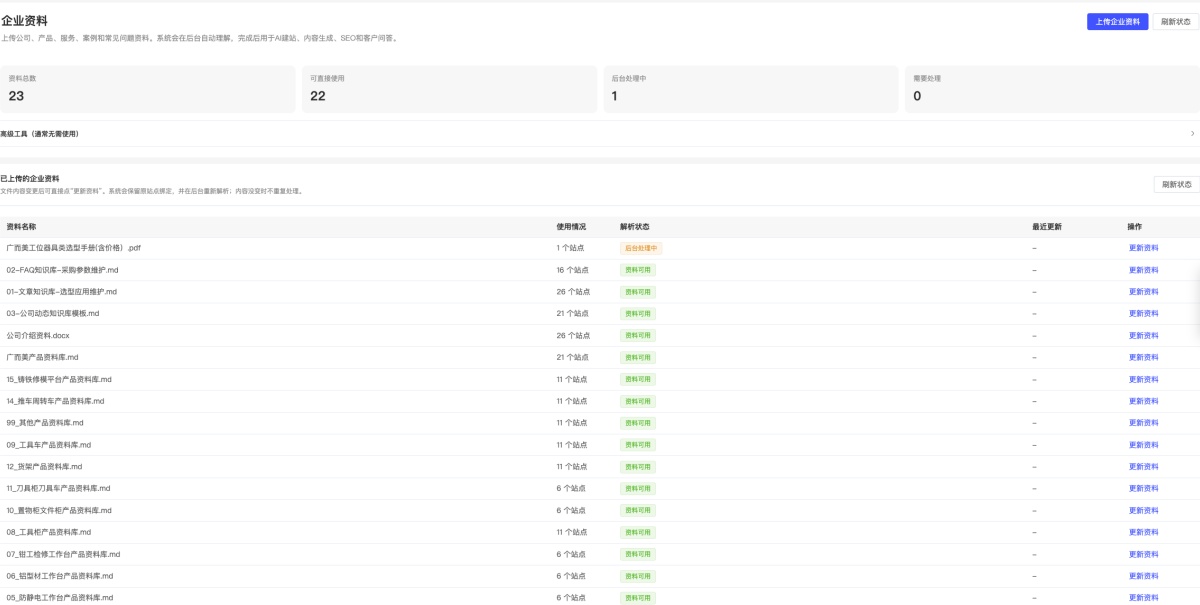
Products Are Not Only Displayed but Also Form a Knowledge Network
For industrial manufacturing websites, simply uploading hundreds of products does not equal the establishment of digital assets.
What is truly valuable is to:
**Products
- Product Categories
- Usage Scenarios
- Selection Questions
- Technical Knowledge
- Industry Applications**
gradually connect them together.
For example, an "anti-static workbench" product should not just have product images, dimensions, and descriptions.
Continuous content can also be built around it:
- Which workshops are suitable for anti-static workbenches?
- Why do electronic assembly workshops need anti-static workbenches?
- What are the common types of anti-static work surfaces?
- How should the load capacity of a workbench be selected?
- How should workbench dimensions be planned based on the workstation layout?
- What is the difference between an anti-static workbench and a standard workbench?
Through continuous content expansion, a single product gradually forms a complete professional knowledge network.
AI Worker enables automated operations for the website
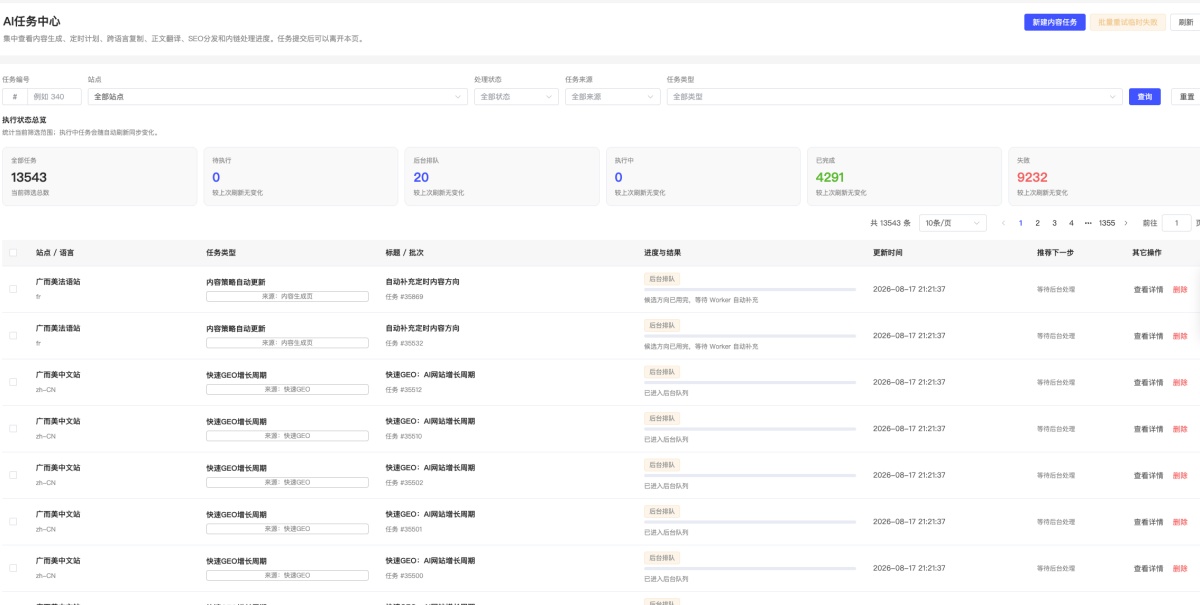
This project further introduces the AI Worker automated operations mechanism.
Traditional enterprise website content operations usually rely on manual work:
Topic selection → Article writing → Checking → Revising → Publishing.
As the number of products and articles increases, this method becomes difficult to sustain long-term.
AI Worker, on the other hand, automatically executes according to pre-set operational tasks.
For example:
Generate professional content daily/weekly according to specified product categories and content directions.
Once generated, it is not published immediately.
Instead, it enters a complete content quality process:
Task Trigger
↓
AI Knowledge Base Call
↓
Content Generation
↓
Automated Inspection
↓
Issue Repair
↓
Quality Scoring
↓
Meets Standards
↓
Enter Scheduled Publishing Queue
Content that does not meet the standards will not be published directly, but will continue to be repaired or reprocessed.
Transform AI from a mere "article writing tool" into an automated content operation unit for enterprise websites.
Automated Content Inspection and Repair
After AI generates the content, the system will further check the content quality.
Inspection content may include:
- Whether the title matches the body text
- Whether the content structure is complete
- Whether there is obvious repetition
- Whether it deviates from the enterprise's actual business
- Whether enterprise product knowledge is used correctly
- Whether there is abnormal language mixing
- Whether the content format meets the requirements
- Whether product names and categories are accurate
- Whether there are unreasonable expressions
After issues are found, it can automatically enter the repair process.
Through:
Generation → Inspection → Repair → Re-scoring
Establish a closed loop for content production.
This ensures that website content operations no longer rely entirely on manual article-by-article checks.
Control publishing standards through quality scoring
The system can score the generated content according to preset content quality rules.
Only content that meets the publishing standards enters the subsequent scheduled publishing process.
Therefore, automation does not mean:
"Publishing whatever the AI generates."
Instead:
AI automatically produces content, while AI automatically performs quality control.
This is especially important for industrial enterprises with a large number of products and long-term content needs.
Enterprises can improve content production efficiency while maintaining a basic threshold for content quality.
Automated internal link matching connects articles with each other.
As the number of website articles increases, simply continuing to generate new pages is not enough.
If a large amount of content is isolated from each other, the website ultimately becomes just a collection of pages.
Therefore, this project further adopts an automated internal link matching mechanism.
After a new professional article is generated, the system can, based on the content's:
- Products
- Product categories
- Application scenarios
- Industries
- Related questions
- Existing professional content
automatically find suitable internal pages to link to.
For example, an article:
"How to Choose an Anti-static Workbench for an Electronic Assembly Workshop?"
can be automatically linked to:
→ Anti-static workbench product category
→ Corresponding product details
→ Workbench customization content
→ Electronic manufacturing industry applications
→ Other anti-static knowledge articles
Thereby gradually forming:
Articles link to products
Products link to categories
Categories link to applications
Applications link to solutions
Knowledge content is interconnected
Allowing the website to gradually form a complete enterprise knowledge network from a large number of independent pages.
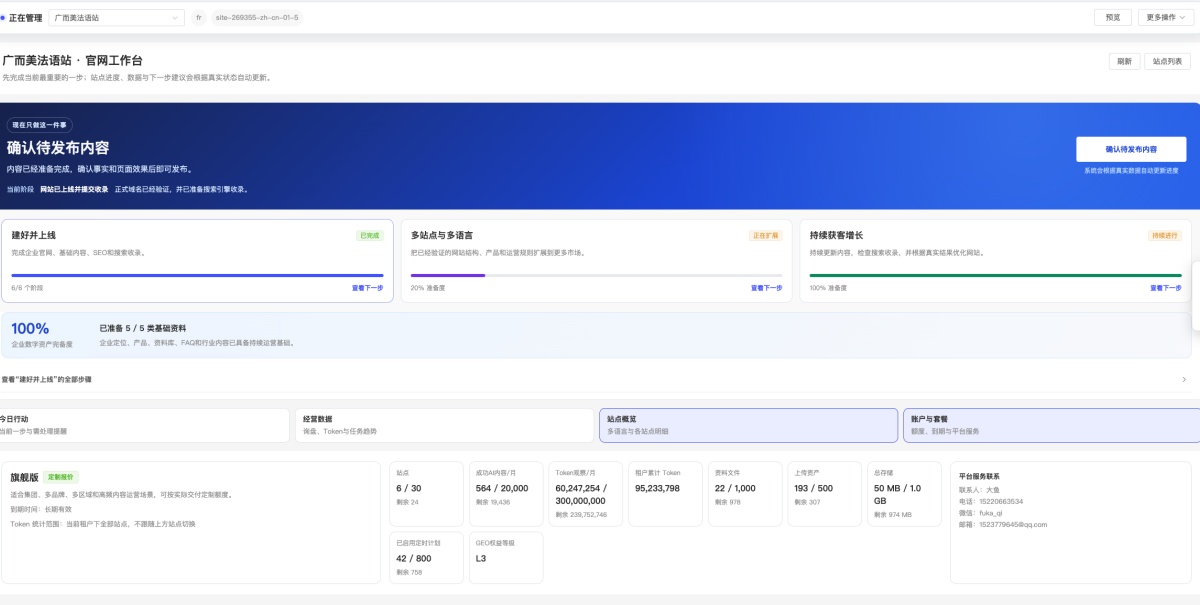
Upgrading from a product catalog to an industry content system
Guangermei's products do not correspond to a single industry.
The enterprise's products are widely used in:
- Manufacturing workshops
- Electronic assembly
- Automotive parts
- Hardware molds
- Maintenance and testing
- Warehousing and logistics
- Experimental testing
- Vocational technical training
Therefore, in addition to being built according to product categories, website content can also be continuously generated according to actual application scenarios.
For example:
How to plan turnover equipment at automotive parts production sites
How to choose heavy-duty mold racks for mold workshops
How to configure anti-static workbenches for electronic workshops
How to design tool cabinets for maintenance workstations
What configurations should be focused on for fitter training benches in vocational colleges
In this way, the website gradually shifts from:
"What products we sell"
Expanding to:
"How different enterprises should solve problems in different scenarios".
The AI enterprise knowledge base ensures content revolves around real business.
The premise of AI Worker automated operations is not to let AI act freely.
The core of the system remains the AI enterprise knowledge base.
Guangermei's:
- Company information
- Product materials
- Product categories
- Product features
- Customization capabilities
- Application scenarios
- Industry focus
All serve as an important basis for AI content generation.
The entire content operation logic forms:
Authentic enterprise materials
↓
AI enterprise knowledge base
↓
AI Worker task strategy
↓
Automated content generation
↓
Automated inspection and repair
↓
Quality scoring
↓
Scheduled publishing of qualified content
↓
Automated internal link matching
↓
Continuous growth of enterprise digital assets
Project value
For manufacturing enterprises with hundreds of products, the real challenge of the website is not "whether there are product pages," but whether these product materials can be continuously transformed into professional content that customers can understand and use.
Through this project, Guangermei has gradually established:
**Product knowledge base
- AI automated content operations
- Content quality control
- Automated publishing
- Internal link knowledge network**
that constitute the enterprise digital asset system.
With the long-term operation of the website, new products, new scenarios, new issues, and new industry knowledge can continuously enter the AI knowledge base and be further converted into new digital content.
What the enterprise ultimately obtains is not just a website displaying 394+ products, but a system capable of continuous automated operations around extensive product materials:
A digital asset platform for industrial manufacturing enterprises.