

138 Enterprise Email | English AI Digital Asset Dedicated Website Case Study
An English digital asset dedicated website for enterprise email built for global business users. It leverages an AI knowledge base to continuously build comprehensive content on global email communication, security, migration, multi-device usage, and professional FAQs.
Specifications
- Industry
- Enterprise Email / SaaS / Enterprise Services / IT Communications
- Brand
- 138 Enterprise Email
- Language
- English
- Target Market
- Global English-speaking Market
- Project Type
- AI Digital Asset Dedicated Website
- Content Model
- AI Enterprise Knowledge Base Driven / Independently Localized English Generation
- Content Scope
- Products / Global Communications / Email Security / FAQ / Academy / Customer Cases / Help Center
- Operational Status
- Continuously Operating
Project Background
Based on enterprise-owned domains, 138 Enterprise Email provides organizations with services such as enterprise email communication, account management, security protection, global communication, and multi-terminal usage.
As service scenarios expand to more cross-border and international enterprise users, relying solely on Chinese product materials is no longer sufficient to fully meet the information needs of overseas customers regarding email communication, security, and system usage.
Therefore, this project builds an English dedicated website based on the enterprise AI digital asset growth system.
The English website shares the enterprise's authentic product and technical knowledge with the Chinese website, but the content is re-planned according to the usage scenarios of global English users, making it an independently operable English enterprise knowledge and business portal.
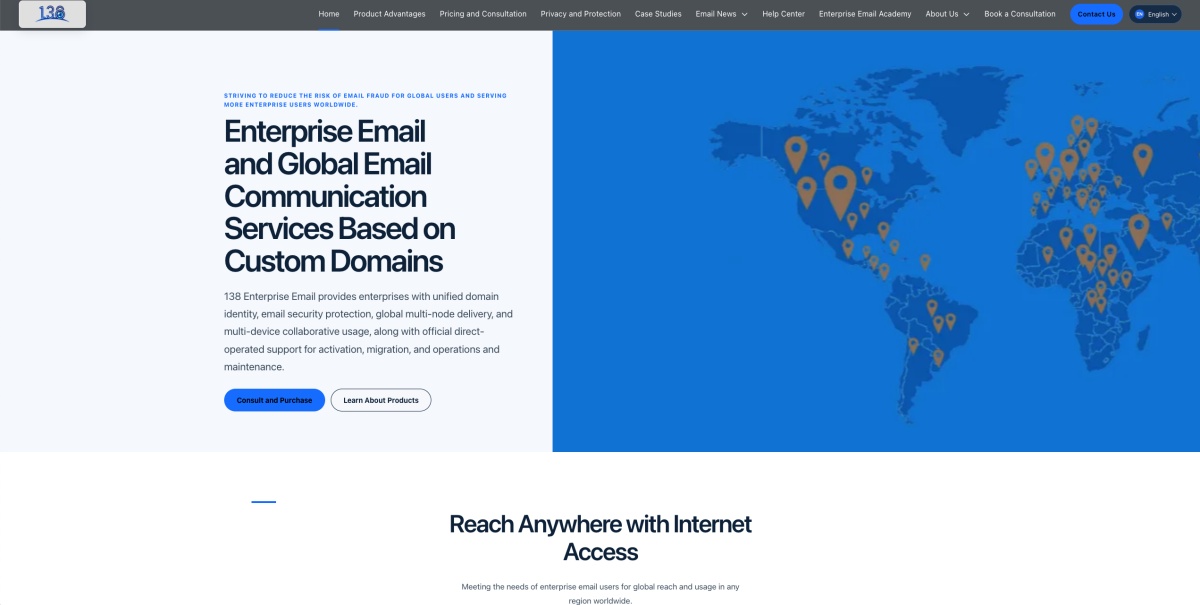
Establishing Core Cognition with Enterprise-Owned Domains and Global Email Communication
The homepage of the English website uses:
Enterprise Email and Global Email Communication Services Based on Custom Domains
as its core positioning.
First, it clearly conveys two key concepts to international users:
Enterprises use their own domains to establish a unified email identity
and:
Providing enterprise email communication capabilities for global business scenarios.
This explains the difference between the product and ordinary personal email better than simply using "Business Email" as the product name.
For cross-border enterprises, email is not only a communication tool but also a part of the enterprise brand identity and business collaboration system.
Reorganizing Content Around Global Communication Scenarios
When using email, the issues that cross-border enterprises focus on have obvious differences from those in purely domestic office scenarios.
For example:
- Whether emails with overseas customers can be sent and received normally
- How Chinese and overseas teams collaborate via email
- How to access the enterprise email from different networks and regions
- How enterprise domains establish a trusted sender identity
- How to reduce the risk of emails being rejected or identified as abnormal
- How to keep emails synchronized across different terminals
- How overseas employees can log in securely
Therefore, the English website does not just display email functions, but further builds content around the global enterprise email usage environment.
On the website homepage:
Reach Anywhere with Internet Access
This is a direct reflection of this global usage positioning.
Transforming email technology into questions that global enterprises can understand
Enterprise Email involves a large amount of professional email technology.
For example:
- SMTP
- POP
- IMAP
- SPF
- DKIM
- DMARC
- DNS
- IP Reputation
- Authentication
If presented directly in the form of technical parameters, it is not friendly to ordinary procurement personnel.
Therefore, the English website further transforms these technical capabilities into business questions through the AI enterprise knowledge base, such as:
How can a company use its own domain for business email?
Why do SPF, DKIM and DMARC matter for enterprise email?
How can international teams access company email across devices?
What should a company check before migrating its existing email system?
How can businesses reduce spoofing and phishing email risks?
Allowing professional technology to gradually become enterprise knowledge content that customers can actively search for and understand.
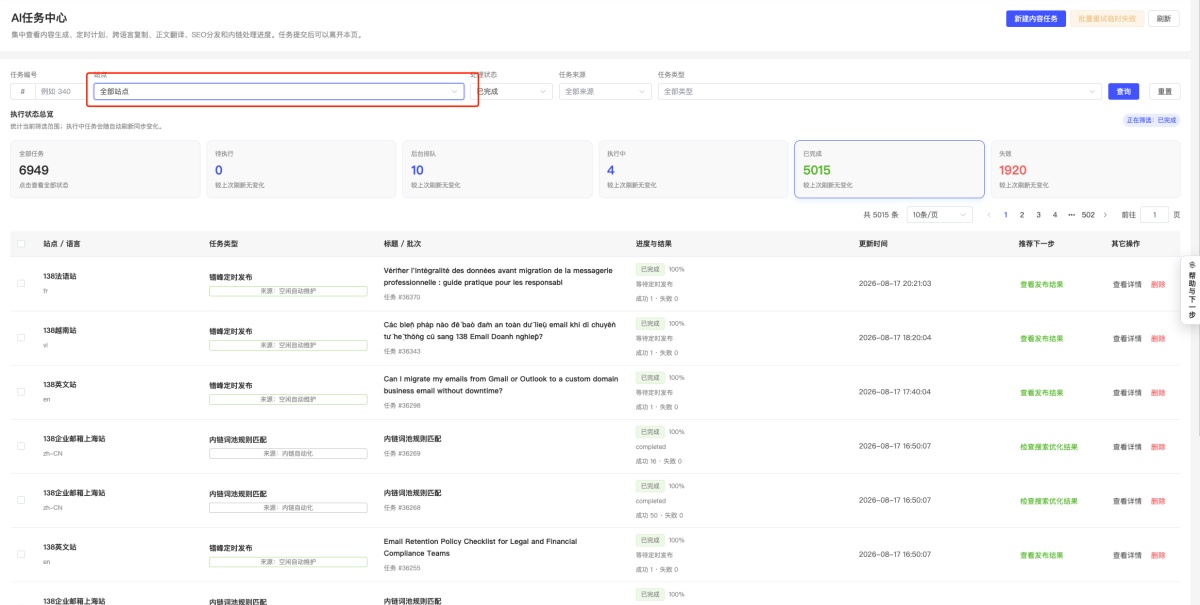
Unified knowledge base, English content generated independently
The content of the English website is not written on the Chinese website first and then translated in batches.
Enterprise product materials, technical materials, service rules, security capabilities, and case facts first enter the unified AI enterprise knowledge base.
Afterwards, it is regenerated according to the content direction of the English market:
- Product Content
- Email Security Knowledge
- Help Articles
- FAQ
- Enterprise Email Academy
- Migration Guides
- Global Communication Content
- Industry Use Cases
Thus, the entire English content system is formed:
Enterprise Knowledge
↓
AI Enterprise Knowledge Base
↓
English Content Strategy
↓
Localized English Generation
↓
Independent English Website
What is shared are enterprise facts and technical knowledge.
What is independent are language expression, article topics, FAQs, and content operation strategies.
The English FAQ is independently built around global users.
The English website FAQ is not required to correspond item by item with the Chinese website.
For example, it can be independently formed around global enterprise users:
- Can I use my own company domain for email?
- How do I migrate from another enterprise email provider?
- Can employees use Outlook or other email clients?
- How does DKIM help verify outgoing email?
- What should I do if emails are frequently rejected?
- How can overseas employees access the mailbox?
- How should a company handle employee email accounts after resignation?
- What should be checked before changing MX records?
These questions come from the enterprise's real product capabilities and customer usage scenarios, but the content can be directly and independently generated in English.
Therefore, the English FAQ itself is an important digital asset for the enterprise facing the global market.
Establish a professional content system for the Enterprise Email Academy
Compared to traditional enterprise email official websites that only provide product descriptions, the English website can further:
Enterprise Email Academy
Continuously building enterprise email knowledge content.
Content can cover:
- Enterprise Email Basics
- Email Security
- Domain Authentication
- Global Email Communication
- Email Migration
- Account Management
- Anti-Phishing Practices
- Client Configuration
- Cross-Border Email Usage
This content is not simply to increase the number of articles.
Instead, it gradually organizes the enterprise's long-accumulated product, technology, and service experience into public, sustainable professional knowledge.
Upgrading the website from "selling enterprise email" to:
A knowledge platform that helps enterprises understand and correctly use enterprise email.
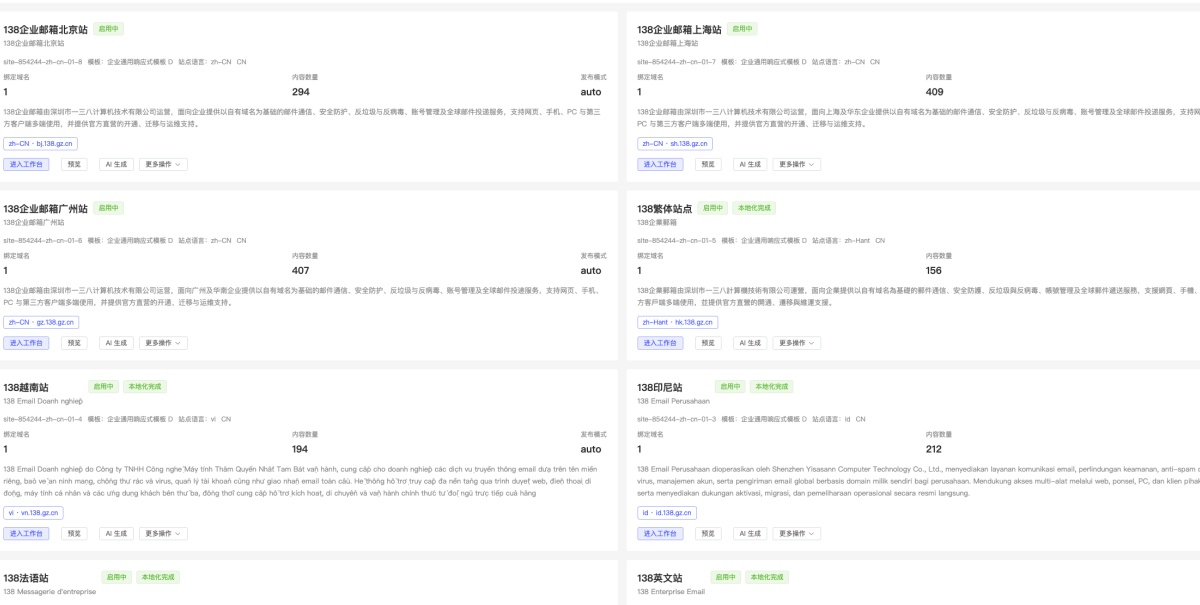
Integrating security capabilities into real business scenarios
Email security is an important component of enterprise email products.
However, the English website does not simply express security as:
Secure Email
Instead, it further explains the value of security through practical scenarios.
For example:
- Preventing enterprise domains from being spoofed
- Identifying abnormal senders
- Reducing the risk of phishing emails
- Managing employee login permissions
- Reducing account risks caused by weak passwords
- Conducting secondary verification for financial payment emails
In this way, overseas users can understand the relationship between technical security mechanisms and daily business operations.
Supporting multi-terminal collaboration for cross-border teams
Global enterprise users often use the following simultaneously:
- Webmail
- Mobile Devices
- PC Clients
- Outlook
- Foxmail
- Other Standard Mail Clients
Therefore, the English website further integrates multi-terminal capabilities with cross-border team collaboration.
Whether in the office, on a business trip, or in overseas regions, enterprise employees need to access the organization's email through appropriate terminals.
Through standard email protocols, multi-terminal usage instructions, and authentication knowledge, enterprise customers can gain a clearer understanding of email deployment and daily usage methods.
Email migration is also an important knowledge asset
For customers already using other enterprise emails, "how to migrate" is often more critical than "what features are available".
Therefore, the English website can be independently and continuously developed with:
- Migration Preparation
- MX Record Switching
- Account Migration
- Historical Email Migration
- Client Reconfiguration
- SPF / DKIM / DMARC Verification
- Rollback Planning
and other content.
This allows potential customers to understand the steps and risks involved in enterprise email migration before formal consultation.
Upgrading from a product official website to a global enterprise email knowledge portal
Traditional English enterprise email websites usually adopt:
Product → Price → Contact
a simple path.
This project further establishes:
Business Need
→ Enterprise Email Knowledge
→ Product Capability
→ Security & Global Communication
→ FAQ / Academy / Help Center
→ Consultation
Enabling the English website to simultaneously serve as:
the brand official website, product official website, help center, and enterprise email knowledge base
and other multiple digital asset roles.
Project Value
Through the construction of the English digital asset dedicated website, 138 Enterprise Email further organizes its originally scattered product capabilities, email technology, security knowledge, service experience, and global usage scenarios into English digital content.
Relying on the AI enterprise knowledge base, the articles, FAQ, Help Center, and Enterprise Email Academy content on the English website can continue to expand independently.
What the enterprise ultimately owns is not just an "English version of 138 Enterprise Email", but a long-term asset built for global enterprise users:
Enterprise Email Digital Knowledge Asset.
This ensures that the enterprise email capabilities can not only be sold globally, but also continuously understood, used, and accumulated in English.